Health policies in the Gaza Strip during the Corona Virus crisis
- Details
- Published on 22 December 2020
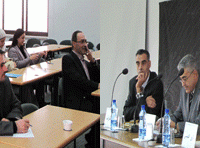
Gaza – Tuesday 16 June 2020, The Institute of Law at Birzeit University, organized a legal encounter entitled “Health policies in the Gaza Strip during the Corona Virus crisis”.
Dr. Osama Bil’awi, has first explained what is meant by a health system, as it is used to define the whole group of organizations, institutions and resources that aim to improve the health, and the system’s needs to employees, funds, information, means of transportations and communication, and general directives. Dr. Bil’awi has also mentioned that the health system is based on six pillars; the leadership and governance of the health system; technology and the computer system; the funding; the healthcare institutions and the health services; human resources; and finally the pharmaceutical products and the medical supplies.
Dr. Bil’awi then presented statistics of the Covid 19 pandemic on a universal scale, and the statistics on the local level in the Gaza Strip. He mentioned that the number of confirmed cases in Gaza is 72, of which 45 has recovered, which leave us with 26 active cases. The compulsory quarantine for travelers entering the Strip from all the crossings was implemented on the 15th of March, and there were two hospitals used as quarantine hospitals; the European Hospital, and a field hospital built in Rafah.
Dr. Bil’awi went on speaking about the response of the Palestinian health system, which includes the structural framework and the response committees, public policies, and the certain procedures that were implemented. He also explained the general purposes of the emergency plan, which includes: strengthening the governance and the management of the response to Covid 19, ensuring the provision of the health services and its continuation, the support services related to Covid 19, and strengthening the health education, and the support of human resources, and the provision of pharmaceuticals, medical devices, and logistics support.
Dr. Bil’awi then went on evaluating the local response to Covid 19 pandemic, of which informing the public is an important part. Providing the tests and the treatment, protecting the doctors and all those who work on the front line, lessening the risks of the propagation of the virus in prisons, providing water and improving the hygiene, and managing the crisis in way that respects human rights and being able to deal with the effects of social distancing are all standards for evaluating the local response to the pandemic.
In the end of the encounter the participants were given the opportunity to discuss the matter. Many questions were asked, comments were made and recommendations were given. To mention few of these recommendations: the importance to manage the crisis in a way that guarantees the respect of human rights, the procedures taken that aim to limiting the movement of the citizens, and to stop some of the medical treatment and operations shouldn’t limit the right of elderly people, people with disability, and the mother and child access to healthcare, and the need to establish a developed system of contact tracing, and working seriously on limiting the economic effect of the pandemic to respect the economic rights of every individual, including those with limited income, and those working in free professions, and ensuring that the most vulnerable don’t lose their housing because of their inability to pay the rent.
The Annexation Projects: the Political and Legal Implications
- Details
- Published on 22 December 2020

The Institute of Law on Wednesday, 10 June 2020, with support from Konrad-Adenauer-Stifitung, has organized a legal encounter entitled “The Annexation Projects: the political and legal implications”. The encounter took place through Zoom. The speakers were: Ms. Suhad Bishara, a lawyer and the head of the Land and planning department in Adalah – The Legal Center for Arab Minority Rights in Israel, Mr. Jamal Jum’a the coordinator of Palestinian Grassroots Anti-apartheid Wall Campaign, and Dr. Hasan Jabarin, a lawyer and the director of Adalah, as part of Birzeit Legal Encounters program, that the institute organizes in the West Bank and the Gaza Strip.
Jamil Salem welcomed the participants. Ms. Suhad Bishara was the first speaker; she gave an analysis of the legal aspects of the expected annexation operation. She emphasized on a very particular point; while the common discourse circulating, that the annexation project doesn’t change the situation on the ground, as annexation is considered to be the core of the Zionist project, and has always existed, therefore there is nothing new in that project, is true, nevertheless it is not very accurate. If annexation takes place, no matter how big or small the annexed parts of the land are, it will bring with it a large number of discriminatory laws – such as those promulgated in the 1950s – and extend its application to the annexed parts. Palestinians can easily imagine all the devastating consequences such laws can have, laws that implicitly aims to force the local population to evacuate the land.
On the International law level, the annexation discourse represents new challenges for the Palestinian researchers, academics, and jurists. Israel has always violated international law norms in the OPT, however until now those violations have been dealt with singly and separately, the Israeli overt decision of annexing parts of the West Bank, even if it is not executed anytime soon, renders the colonization a systematic and an ongoing act, therefore posing serious questions on how to deal with the Israeli system, how to define that system as a whole, and how to frame, analyze and expose the Israeli practices.
The second speaker was Mr. Jamal Jum’a, it was a very practical intervention, where Mr. Jum’a displayed a map made by the well-known Dutch cartographer Jan de Jong. He gave a complete and detailed explanation of the geographical aspects of the Israeli colonial project in the West Bank, which started in 1967.
Mr. Jum’a showed, on the displayed map, the areas targeted by the annexation, which includes mainly the east of the West Bank (the Jordan Valley) but also its west. One could be surprised when realizing that the western villages of Ramallah, Selfit, and the villages situated to the north west of Jerusalem. Mr. Jum’a went on explaining the great economic damages that would follow from the annexation of these areas. The Jordan Valley is the most important source of livestock in the West Bank, an important percentage of the agricultural wealth will be also lost, but most importantly is water resources, in fact, water resources in the West Bank are concentrated in the areas that will be annexed in the eastern and western parts of the West Bank. Mr. Jum’a finished his intervention by exposing the numerous difficulties that Palestinians will face in their daily life if the annexation takes place, most importantly the additional obstacles added to the freedom of movement.
The third and last intervention was that of Dr. Hasan Jabarin. He started his intervention from the point Ms. Bishara has emphasized; the annexation is de acto taking place, and this has been the case since 1967, and the very particular status of Jerusalem is by far the clearest example. The question therefore is “what is new?” “What has changed?” “why evoking the matter of annexation now?” The difference now is that the annexation we’re talking about is an annexation according to the Israeli law, the whole current discussion turns around one essential point; will Israel promulgate a clear and overt law through which it explicitly declares that parts of the West Bank are now subject to its sovereignty and accordingly constitutes a part of the Israeli State? It is this particular point that causes all this controversy.
The step of promulgating a law that will legalize the annexation raises a heated debate inside Israel too. Up until now, Israel has been very reluctant when it comes to promulgating overtly racist laws; they would rather impose the facts on the ground than legalizing such practices. It is what differentiate it from the Apartheid system in South Africa; the Israeli legal culture does not legalize racism. So the main question is therefore will the annexation be applied according to a law? Or without it? And if the law is promulgated will that mean that the Israeli legal culture has changed towards one that is much more similar to that of the Apartheid regime in South Africa? Or will it continue with its traditional culture of practicing racism on the ground without the interference of law? This is not a simple matter and it is a very controversial issue inside the Israeli society.
Dr. Hasan expected a sever opposition inside the Israeli community to the annexation project. The international community, on the other hand – if we excluded the U.S. which supports the annexation – sees in in this project an end to the European project; the European project is based on one principle “two states for two people”, therefore we are waiting to see the position of the international community. As for the Palestinian position, Dr. Hasan expects that annexation will change the Palestinian discourse back to the discourse of “the right to self-determination”. In his opinion if annexation takes place – and the new de facto situation extends in time – along with an American support, a European and International silence, and an Arabic and Palestinian weakness, this will make the situation – with time – go back to what it was in the 1950s and 60s – No Palestinian State. This strike for the Palestinian State project, will force Palestinians to change their right discourse and adopt again “the right to self-determination” discourse, that discourse which provoked an enormous worldwide echo in the 1970s and 80s, but has dimmed during the past two decades.
Around 100 participants attended the legal encounter. The participants were then given the opportunity to comment and ask questions.
An Overview of the Law by Decree on Social Security
- Details
- Published on 11 May 2016
 Gaza - Wednesday, 11 May 2016: In partnership with the Konrad Adenauer Stiftung - Palestinian Territories, the Institute of Law (IoL) of Birzeit University organised a legal encounter,
The Institute of Law (IoL) at Birzeit University, in partnership with Konrad Konrad Adenauer Stiftung (KAS), organized a legal encounter in Gaza regarding "Housing rights in light of mass displacement during the 2014 war on Gaza"
- Details
- Published on 06 November 2018

The Institute of Law, Birzeit University, in partnership with Konrad Adenauer Stiftung (KAS), organized a legal encounter in Gaza, regarding "Housing rights in light of mass displacement during the 2014 war on Gaza". The meeting was held on Thursday, 1 November 2018.