The Reality of Working Women's Participation in Justice Facilities
- Details
- Published on 18 May 2022
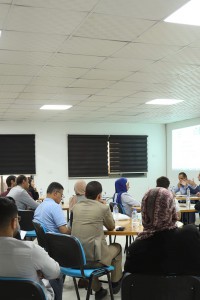 On Wednesday, 18 May 2022, the Institute of Law (IoL) of Birzeit University held a legal encounter on The Reality of Working Women's Participation in Justice Facilities. Bringing together a number of lawyers, members of the legal community, and female police officers, the presentation was made by Dr. Mohammed Suleiman Shubeir, Associate Professor of Administrative Law at the Faculty of Law, Al-Azhar University.
In her opening remarks, Ms. Lina al-Tounisi, Coordinator of the IoL Gaza Office, welcomed the speaker and audience and made a briefing note about the Birzeit Legal Encounters Programme. Dr. Shubeir discussed the role and impact of female staff members of justice facilities in the Gaza Strip on maintaining the privacy of women when they listen and provide legal advice to these women. Dr. Shubeir stressed the importance and role of female lawyers in women’s access to justice.
Dr. Shubeir addressed three issues. Firstly, in relation to the reality of working women’s participation in police and security services, positive engagement with the cases of battered women requires the participation of women working in justice facilities of all kinds. This support starts with recruiting female police officers who could deal with women, both as complaints and defendants, ensuring their privacy, providing all comforts, giving confidence, and encouraging them to move forward to access justice. In this context, Dr. Shubeir highlighted that what was needed was not a women’s police force. Rather, the tasks and powers of the Family and Children Departments at police stations should be enhanced and promoted. He indicated that women’s representation in the police service was low.
Secondly, on women’s participation in the Public Prosecution, Dr. Shubeir showed that there were five or six female assistants to prosecutors. Compared to 75 male prosecutors, there is not a single female prosecutor. Female presence in the Public Prosecution is a key requirement for access to justice in gender based cases. This is a constitutional requirement, which has a positive bearing on women. The absence of female investigators, criminologists, and judicial officers will negatively impact female complainants and defendants. On the other hand, male investigators find it extremely difficult to understand women’s psychology. When they feel embarrassed in some cases, women’s psychological condition drives them to take a passive attitude without hesitation.
Thirdly, Dr. Shubeir explored the impact of women’s participation in the judiciary on women’s right to legal recourse and access to justice. There are only two female judges out of 70 judges in Gaza. Procedures for applications for judicial office have made it difficult for women to be appointed as judges. Women are absent from courts. Court proceedings are so critical as they culminate in decisive judgements, which put an end to disputes and cases. As a consequence, women are deprived of their rights in cases to which they are parties. Female judges may, therefore, provide a crucial factor to support women. Female judges have the skill of recognising body language as well as drawing statements and facts. Dr. Shubeir made clear that the very low presence of women in the justice sector components was attributed to the nature of the patriarchal society of Gaza and to the way advertisements for judicial posts are drafted. In addition to the religious nature of the community, the public have recourse to informal (tribal) judicial system in some cases in general, and in cases involving women in particular. This was one of the key reasons that cause women to refrain from applying for judicial posts at different legal facilities.
Many interventions and recommendations were made in ensuing discussion. Most importantly, the principle of women’s access to justice needs to be consolidated by putting in place mandatory constitutional provisions. Effective laws should be amended to preserve the rights of women, including complainants, addressees of complaints, litigants, and defendants. In addition to defending themselves as they desire, women will be enable to make statements in full freedom and without hesitation. To this avail, women will be strongly visible throughout justice sector facilities. In particular, when they defend themselves in certain cases, women need to be heard by fellow women in issues of privacy and gender.
The Health Rights of Gaza Patients and Patient Transfers
- Details
- Published on 10 May 2022
 On Thursday, 21 April 2022, the Institute of Law (IoL) held a legal encounter on The Health Rights of Gaza Patients and Patient Transfers. Bringing together members of the legal community, academics, and interested persons, the presentation was made by Mr. Ala’ as-Skafi, Director of the Al-Dameer Association for Human Rights, and Dr. Osama Bal’awi, a health consultant.
In her opening statement, Ms. Lina al-Tounisi, Coordinator of the IoL Gaza Office, welcomed the speakers and audience and made a briefing note about the Birzeit Legal Encounters Programme. As-Skafi explained the definition of the concept of health in International Humanitarian Law and right to health under Palestinian laws. The Palestinian Basic Law does not address the right to health directly. Instead, Article 10 of the Basic Law provides for compliance with fundamental human rights and freedoms. Accordingly, the Palestinian Authority will work without delay to accede to international conventions and declarations, which provide protection to human rights. As-Skafi demonstrated that the Palestinian Public Health Law No. 20 of 2004 assigns a set of tasks to the Ministry of Health (MoH), particularly maternal and child care, control of diseases and pandemics, quarantine, hospital, and clinic services. However, the law does not address important aspects, including the provision of health insurance and issues relating to the older population and people with disabilities.
As-Skafi elaborated on the 2000 General Comment No. 14 of the Committee on Economic, Social and Cultural Rights. The interpretation of the right to health comprises interrelated and essential elements, namely, availability, accessibility, acceptability, and quality of health care services. Finally, As-Skafi stressed the continuing complexities and obstacles, which face patients, constitute a violation of the right to health, run counter to the principle of progressive realisation of the right to health under the International Covenant on Economic, Social and Cultural Rights, and contradict the Palestinian National Health Strategy 2017-2022.
In his presentation, Bal’awi addressed the concept of specialised treatment and department of service purchase (treatment outside MoH facilities). The MoH is committed to working jointly with all partners to scale up and improve performance, and ensure professional management, of the health sector. The Palestinian government has put in place the patient transfer system to make up for shortfalls at governmental health facilities as well as the lack of medical experience, devices, and equipment, including specialties of the medical profession and ability of medical facilities to accommodate patients. This way, gaps are bridged by the purchase of medical services from local health providers outside the MoH, including private, civil society, or charitable health institutions. Also, medical services can be purchased from other countries in case they are unavailable at local health centres.
Simple cases are transferred to local hospitals in the Gaza Strip as well as to national hospital, which require that patients cross the Beit Hanun (Erez) crossing point. These include the An-Najah hospital in Nablus and Al-Makassed and Augusta Victoria hospitals in Jerusalem. Patients whose treatment is not available in the Gaza Strip are transferred to hospitals inside the Green Line, including the Hadassah Ein Karem, Tel HaShomer hospitals, etc. Bal’awi made an overview of the total number of annual patient transfers. In 2019, patient transfers totalled 104,881. Representing a decrease of 23.7 percent, 80,020 patients were transferred to health centres outside MoH facilities in 2020.
Bal’awi indicated that the period required for the approval of a patient transfer application ranges from two to three weeks. In the meantime, an appointment is made, taking into account the availability of medical services or procedures. The cost of patient transfers is mostly covered by 100 percent. On the other hand, patients contribute 5 percent to the cost of other services. Patients and their families cover indirect costs, including companions, transportation, and accommodation.
Many interventions and recommendations were made in ensuing discussion. Most notably, an integrated set of health services needs to be provided, including medical specialties for which patient transfers are needed most, such as cancer, heart surgery, and cardiac catheterisation, at MoH or private hospitals. The Palestinian health system will be improved and capacity building provided to medical institutions. Qualified medical staff will be recruited to train physicians in the Gaza Strip. Medical teams will be dispatched on external missions for rehabilitation and then return to work at local hospitals.
Scholars, researchers dissect recent Gaza judicial announcements on women’s travel, post-divorce compensation
- Details
- Published on 22 March 2022
 Continuing its series of legal symposia focused on newly enacted laws and regulations in Palestine, Birzeit University’s Institute of Law organized a discussion on the Sharia Judiciary Council in Gaza’s judicial announcements regarding travel restrictions on women over 18 as well as compensation for women after an arbitrary divorce.
The symposium, held on Tuesday, March 22, 2022, was chaired by Lina Al-Tonisi, the Institute of Law’s administrative coordinator in Gaza, and featured Abdallah Sharsharah, a lawyer and legal expert.
In his discussion, Sharsharah tackled the Sharia Judiciary Council’s judicial announcements from two interrelated standpoints: whether the council has the legal power to produce such wide-ranging announcements that border on legislation, and whether the announcements themselves run afoul of any established legal precedents.
Regarding the first point, Sharsharah defined the Sharia Judiciary Council as an independent legal entity that oversees the work of Sharia courts in Gaza, formulates policies to advance Sharia judiciary, appoints judges, and proposes laws and regulations relevant to its purview. Producing broad judicial announcements based on independent legal reasoning, Sharsharah argued, is not explicitly part of the council’s purview. As such, the judicial announcements may violate the principle of judicial independence.
Discussing the recent judicial announcement regarding women’s rights to compensation after an arbitrary divorce, Sharsharah explained that the announcement, while providing women with recompense, supersedes the 1954 Law of Family Rights, which regulates, among other aspects, marriage and divorce. The judicial announcement, as Sharsharah concluded, is invalid.
After wrapping up the discussion, Al-Tonisi gave the floor to the attendees, who along with Sharsharah discussed several recommendations addressing gaps in the Law of Family Rights adopted in Gaza.
Students, legal researchers explore impact of amendments on procedural law in Palestine
- Details
- Published on 31 March 2022
 Students, legal researchers, and faculty members discussed the changes introduced by laws by decree on Palestinian procedural law in a symposium organized by Birzeit University’s Institute of Law on March 31, 2022.
The symosium, part of a series organized by the Institute of Law in the West Bank and Gaza, featured legal experts that included judge Fateh Hamarsheh, lawyers and previous judges Raed Asfour, and Daoud Darawi. The speakers focused on recent amendments on the procedural law, evidence, execution, penal acts, and the commercial and civil code.
Mohammed Alkhader, an academic researcher, chaired the session, emphasizing in his opening remarks the destabilizing effects that laws by decree have on court proceedings as well as the system of rights and duties in Palestine.
Hamarsheh, who began the discussion, highlighted the consequences of amending procedural law through laws by decree, arguing that such amendments have an adverse impact on enforcing rights and the rule of law in Palestine. As an example, he discussed the 2022 amendments of the Code of Civil and Commercial Procedure No. 2 of 2001, arguing that such changes as the electronic serving of legal notices or changing the purview of conciliation courts undermine the guarantees to a fair trial and impede the swift administration of justice.
Along similar lines, Raed Asfour discussed the 2022 amendments to the 2005 Law of Execution, noting that they were redrafted from the Jordanian execution law without regard to their relevance to the 2005 execution law or the Palestinian context. Among the more problematic effects of these amendments, Asfour noted, were that enforcement judges no longer handle substantive disputes and an apparent contradiction in how defendants can appeal verdicts ruled in absentia.
Daoud Darawi, the final speaker in the session, criticized the amendments to the 2001 Penal Procedure Law, noting that they’ve hampered the protection of human rights in Palestine. The amendments, Darawi explained, severely restrict how and in what form suits can be brought against public officials, requiring the written approval of the prosecutor general.
At the end of the legal encounter, the speakers gave the floor to attendees for questions, and a group discussion was held regarding how best to address the shortcomings of the law-by-decree amendments.
Legal Problems of Penal Reconciliation in Gaza Strip
- Details
- Published on 22 December 2020
 The Institute of Law (IOL) organizes a legal encounter in Gaza on
“Legal Problems of Penal Reconciliation in Gaza Strip”
Gaza – On Tuesday 17th of November 2020, the Institute of Law (IoL) at Birzeit University organised an online legal encounter via Zoom Platform on “Legal Problems of Penal Reconciliation in Gaza Strip“, which was held in partnership with Konrad Adenauer Stiftung-Palestinian Territories. During this encounter Dr. Sami Ghonaim and Dr. Saher Al Waleed, professors in the College of Law at Al Azhar University, took part in the presentation, as a number of law students from the aforementioned College, jurists and interested individuals also participated.
The encounter was firstly introduced by Lina Al Tunisi, coordinator of the Institute's work in Gaza, whom welcomed the attendees and presented a brief description of the Birzeit Legal Encounters Programme.
Subsequently, Dr. Sami Ghonaim had begun his speech by clarifying the concept of Penal Reconciliation and its theoretical contour, which is considered to be an embodiment of the concept of alternatives to the criminal case procedures that emerged of the traditional criminal justice system crisis, as Penal Reconciliation also aims to achieve a balance between social interests and the punishment of the perpetrator, which represents a special deterrent to the criminal and the application of the idea of general deterrence to those addressing the provisions of the law.
Dr. Ghonaim reviewed the legal aspect of the Penal Reconciliation, as he indicated that countries tend to administer criminal justice through alternatives to the criminal case, which began to make its way in the legal systems, alongside the public lawsuit. Dr. Ghoneim also added that the legislator’s regulation for the Penal Reconciliation in Gaza Strip included many legal difficulties which led to the demand for its amendment, even by its supporters and those who implement it, as many criminals had return to committing crimes, sometimes more serious crimes, which demonstrates the failure of the concept of the perpetrator’s deterrence. Moreover, the rate of crimes in general is on increase, which calls into question the utility of the concept of general deterrence. Besides, the increase in legislative intervention to criminalize new acts, had led to an increase in the number of convicts, and thus an increase in the number of prisoners, which ultimately leads to overcrowding in prisons, and an increase in the financial burden on the state’s shoulders.
In his part, Dr. Saher Al Waleed revised the procedures followed in the enforcement of the Penal Reconciliation Law’s in Gaza Strip, where he explained the concepts of reconciliation and conciliation and the difference between them, and their role in the termination of a lawsuit, in addition to the society’s need for them. In addition, Dr. Al Waleed revised the concept of reconciliation in the Palestinian Criminal Procedures Law, specifically articles 16, 17 and 18, indicating that its impractical as the legislator imposed this concept for violations in general, and misdemeanours punishable with fines, excluding misdemeanours punishable by imprisonment; which is considered impractical as the society desperately needs an expansion in the circle of reconciliation. Meanwhile, the Penal Reconciliation Law of 2017, which is applied in Gaza Strip, has expanded the scope of reconciliation, which includes misdemeanours punishable by imprisonment for no longer than 6 months.
Dr. Al Waleed also addressed the criminal justice crisis between the public lawsuit and its alternatives, as he indicated that the legislator in the Penal Reconciliation Law for 2017 has made a distinction between accepting the reconciliation before the stage of filing the lawsuit and going to trial, and the stage after filing it. Dr. Al Waleed also emphasized that a distinction must be made between the civil and criminal cases.
At the end of the encounter, a discussion between the attendees was present, which included many interventions and recommendations, highlighting the necessity to change the legislator’s philosophy in drafting the law, as it moves away from the ethical view and includes only the utilitarian view, in addition to the importance of applying the law in some cases, such as tax crimes, and the impossibility of applying it on other crimes, such as theft. In addition, the fact that this law is inconsistent with social justice was also highlighted, as it biases with the rich against the poor, while legislations must reflect the societal condition, and prevail over the public interest.
More Articles...
- The Reality of Marginalised Groups in the Light of the Lockdown due to Corona Pandemic in Gaza Strip
- Legal Framework for Regulating the Energy sector in Gaza
- Book: Law and Revolution: Legitimacy and Constitutionalism After the Arab Spring By Dr. Nimer Sultany
- Collecting money in the light of Corona pandemic: between the legal text and the theory of force majeure