A delegation from Birzeit University meets the Minister of Justice
- Details
- Published on 03 November 2018
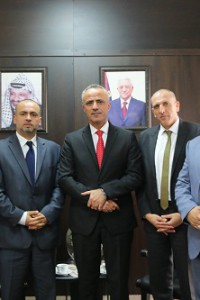 Ramallah, October 25th of 2018 A delegation from the Birzeit University on Thursday, met HE Ali Abu Diak, Minister of Justice. The delegation included Professor Asem Khalil, Vice President for Community Affairs, and Acting Director of the Institute of Law, and colleagues Dr. Mustafa Mari, Mr. Ahmed Nasra and Dr. Rashad Twam.
Participants discussed means of strengthening and upgrading cooperation and joint action between the Ministry of Justice and Birzeit University in areas of mutual interest, including the field of harmonization of legislation, benefiting from the legal expertise accumulated at the University. The accession of the State of Palestine to dozens of international conventions, without reservation, makes it necessary to examine Palestinian national legislation, to ensure compatibility with Palestine’s international undertakings.
The Minister of Justice also gave a brief explanation of the report of the Presidential Commission for the Development of the Judiciary, which submitted its recommendations to the President, in order to develop the judicial system, and to ensure the independence of the judiciary and citizen access to justice.
Participants praised the legislative drafting expertise of the Institute of Law, including the preparation of relevant manuals, the first being the legislative drafting manual in 2000.
It is worth mentioning that the national team which has developed the most recent version of the legislative drafting manual (earlier in 2018), has relied heavily in the preparation of the new version, on its first version, prepared over a decade ago, by the Institute of Law, in partnership with the Office of Fatwa and Legislation and the Palestinian Legislative Council.
In conclusion, Dr. Asem Khalil thanked the Minister of Justice for his warm hospitality, and praised the close cooperation with the Ministry of Justice in various legal fields, stressing the readiness of the University and the Institute of Law in particular, for further cooperation in the harmonization of national legislation and in the area of legislation development in general.
Palestine Yearbook of International Law Call for Papers
- Details
- Published on 21 November 2020
Palestine Yearbook of International Law
Call for Papers
PYBIL Vol. XXIV (24), Submission by 15 March 2022
The Palestine Yearbook of International Law (PYBIL) has opened an invitation for a round of submissions for Volume XXIV. We are interested in particular in critical approaches to public international law, and welcome submissions in relation to Palestine. In addition, the PYBIL welcomes articles on critical legal studies, Third World Approaches of International Law (TWAIL), and Critical Race Theory (CRT).
This peer-reviewed volume would include articles, case commentaries, and book reviews.
-Articles should not exceed 12,000 words, including footnotes. Submissions to the general Articles section will be reviewed by the editorial board in addition to anonymous review by external experts to assess their quality and contribution to academic debates.
-Case commentaries should not exceed 5,000 words, including footnotes. Commentaries should discuss significant and relevant jurisprudential developments, whether in international law tribunals or in domestic courts that are pertinent to international law.
-Book reviews should not exceed 3,000 words, including footnotes. Book reviews would critically engage with recent international law publications. PYBIL is also happy to receive review essays that examine several books. Review essays should not exceed 5,000 words, including footnotes.
Submission guidelines and PYIL style requirements:
Submissions should be exclusive to PYBIL in order to be considered. We will aim to update authors on submission progress in a timely manner.
Authors who would like their articles to be considered for Volume XXIII should submit them by 15 March 2022. Articles submitted at a later stage will be considered for Volume XXV.
Article submissions should include 2 documents: the article file without name of author, and a second file that includes the name of author, institutional affiliation, contact info, and an abstract for the submitted Article (no more than 500 words).
The submission should be double-spaced, with one-inch margins.
The Yearbook follows the legal citation system used by The Bluebook: A Uniform System of Citation, published by the Harvard Law Review Association.
The Yearbook is published in English since 1984. It is edited at Birzeit University’s Institute of Law (Birzeit, Palestine), and published by Martinus Nijhoff Publishers (The Hague, The Netherlands). The Editor-in-Chief of the Yearbook is Dr. Nimer Sultany.
For a list of previous volumes, please see: https://brill.com/view/serial/PYIL
Contact address for submission:
Please submit your article to:This email address is being protected from spambots. You need JavaScript enabled to view it.
Contact address for queries:
Dr. Nimer Sultany, Editor-in-Chief: This email address is being protected from spambots. You need JavaScript enabled to view it.
Mr. Ata Hindi and Ms. Reem al-Botmeh, Assistant Editors: This email address is being protected from spambots. You need JavaScript enabled to view it.
Institute of Law holds legal encounter titled “Legal and Rights-Based Aspects of Enforcing Prepayment Electricity Meters in the Gaza Strip”
- Details
- Published on 13 September 2023
 Institute of Law holds legal encounter titled “Legal and Rights-Based Aspects of Enforcing Prepayment Electricity Meters in the Gaza Strip”
With the support of the Konrad Adenauer Foundation, the Institute of Law at Birzeit University organized a legal encounter under the title “Legal and Rights-Based Aspects of Enforcing Prepayment Electricity Meters in the Gaza Strip.” Held on Wednesday, August 9, 2023, the encounter featured Mohammad Al-Telbani as main guest speaker. The event was attended by a number of human rights activists, lawyers and individuals from the general public.
Al-Telbani initiated his presentation with an in-depth explanation of the international and national protection to the Right to Electricity. He discussed the legal framework regulating the electricity service in Palestine, which comprises a number of laws and decisions, some of which are old and others are modern, such as Law No. 12 of 1995, which established the Palestinian Energy Authority and defined its tasks and functions. In addition to the General Electricity Law and the Renewable Energy Law, other examples include the Palestinian Local Authorities Law No. 1 of 1997, one of the first laws issued by the Palestinian Legislative Council. It defined the functions of the Local Government Units, including supplying citizens with electricity and setting prices within Ministry limits. Additionally, Al-Telbani noted that the main objective of the General Electricity Law of 2009 is to regulate and develop the electricity sector in Palestine and to encourage local and foreign investment in the sector to provide sufficient energy at the lowest prices by establishing the Palestinian Electricity Regulatory Council, a legal entity with financial and administrative independence. Established by a decision from the Council of Ministers, he maintained, the Palestinian Electricity Regulatory Council protects the rights of consumers and prevents forging monopolies.
Al-Telbani then talked about the reality of the electricity sector in the Gaza Strip. He explained that electricity is supplied from three sources: the Israeli lines, which provide up to 120 MW; the Egyptian lines, which have the capacity of 20 MW; and the Gaza Power Plant, a diesel-fired power station that was established in 1999 in the South of Gaza City and commenced operation in 2002. Al-Telbani also highlighted the problems facing the electricity sector in Gaza, such as the insufficiency of energy supply to match the level of demand, the lack of development in the electricity sector and the decadence of the electricity infrastructure despite a 7% growth in electricity consumption due to the expansion of population as well as commercial projects in Gaza. He added that, for the past 17 years, the electricity sector has been operating according to a very restricted power supply schedule, while undergoing increasing hours of power cuts.
At the end of his intervention, Al-Telbani discussed different aspects of the installment of prepayment electricity meters in Gaza. He explained that, as an alternative to old traditional meters, these smart meters were installed by the Gaza Electricity Distribution Corporation for tens of thousands of families in the Gaza strip under the protection of the police. Despite a strong disapproval from the public, the Gaza Electricity Distribution Corporation continues to install these meters across various areas and neighborhoods in Gaza. These new procedures raise a number of issues and challenges that violate individual rights but, at the same time, achieve some benefits, including reducing electricity waste by obliging citizens to conserve electricity and enhancing the financial capacity of the Gaza Electricity Distribution Corporation.
It also solves the longstanding issue of a significant portion of the public defaulting on electricity bills.
The legal encounter concluded with an open discussion that featured many interventions and recommendations, including the necessity of transparency in the electricity field; the necessity of curbing atmospheres that encourage monopolies, conflicts of interest and coercive measures in view of the lack of series attempts to match the increasing electricity demand; and the significance of pursuing comprehensive development that aligns with the citizen needs. This includes ensuring equal access to electricity to all citizens and safeguarding their basic rights in light of the absence of social justice and the deteriorating living conditions of hundreds of thousands of Palestinian families in Gaza.
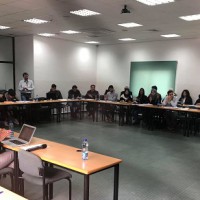
“Statehood Ramifications on Palestine and the Palestinians: Legal, Economic and Political Implications”
- Details
- Published on 06 March 2019
Institute of Law at Birzeit University organizes legal encounter titled “The Impact of Recent Judicial Decisions on the Rights of Retirees Enrolled in the Palestinian Pension Agency in the Gaza Strip.”
- Details
- Published on 18 July 2023

On Tuesday, June 20, 2023, the Institute of Law at Birzeit University with support from the Konrad Adenauer Foundation organized a legal encounter titled “The Impact of Recent Judicial Decisions on the Rights of Retirees Enrolled in the Palestinian Pension Agency in the Gaza Strip.” The event featured Hazem Haniyeh, coordinator of the Monitoring of National Legislations and Policies Department at the Independent Commission for Human Rights, as a main speaker and was attended by a number of human rights activists, lawyers and retirees.
The event was opened by Lina Al-Tunisi, administrative coordinator at the Institute of Law in Gaza, who welcomed the attendees and introduced the Birzeit Legal Encounters program.
Haniyeh provided an overview of the laws issued by the former Palestinian Legislative Council and the Change and Reform Bloc in Gaza as well as the decree-laws issued by the Palestinian president Mahmoud Abbas.
He noted that 98 laws enacted by the Palestinian Legislative Council between 1996 and 2006 and 395 decree-laws enacted between 2007 and 2022 are implemented in the West Bank. On the other hand, Haniyeh explained, Gaza has enacted 82 laws issued by the Change and Reform Bloc in the Legislative Council from 2006 to 2021, emphasizing the multitude of legislations enforced since the Fatah-Hamas split.
He also touched on the recent judicial decisions issued by the Supreme Administrative Court in the Gaza Strip, which oblige the Palestinian Pension Agency to resume the payment of the pension to a number of retirees following its suspension after they obtained a new professional role (membership in the Palestinian Legislative Council) and received employee benefits. Haniyeh also addressed the Palestinian Pension Agency’s decision to suspend its services to all pensioners in Gaza, pending the implementation of these judicial decisions.
Haniyeh also elaborated on the role of the Independent Commission for Human Rights in following up with the cases and compliances of retirees and offering legal services, pointing out that the commission followed up with their cases, contacted relevant authorities in the Palestinian Pension Agency and arrived to a judicial settlement regarding pending issues.
He also addressed the system of laws that regulate the rights and duties of retirees, highlighting key amendments to these laws. Haniyeh elaborated on Article 14 of Decree Law No. 29 of 2018, amending the General Pension Law No. 7 of 2005 that provides for the inadmissibility of combining two pensions. The new amendment stipulates that the assets of the Pension Committee are administratively and legally separate from that of the Public Treasury. It also allows for combining the pension for the period admissible for retirement with any other salary, pointing out that the enforcement of these laws is selective, as not all these amendments are enforced in Gaza.
In conclusion, he emphasized the role and position of the Independent Commission for Human Rights in asserting that retirees' rights are guaranteed by law, as long as the employee enrolled in the committee has met the legal requirements and contributed to the pension fund, it is incumbent upon the Palestinian Pension Agency or any relevant entity to fulfill their assigned role.
At the end of the legal encounter, an open discussion that featured many interventions and recommendations took place. They emphasized the significance of addressing the repercussions of the legal and administrative division, as it undermines the rights of individuals and employees. They also stressed the need to avoid conflating collective decisions with individual cases and to maintain the independence of institutions.
More Articles...
- Workshop at Birzeit University’s Institute of Law Explores Legal Aspects of Information Technology
- Institute of Law in Gaza holds a legal encounter on 'The Compatibility of the Draft Personal Status Law with Women's Rights in Gaza
- Institute of Law in Gaza holds legal encounter on personal status law draft in light of women’s rights
- Protection of Palestinian Content on Social Media: Between Rights and Law